
Library Articles of Interest
How to Be Creative When You're Not Naturally Creative
- Details
- Hits: 415
How to Be Creative When You're Not Naturally Creative
Written by Brittany Gellerman | @brittgell
"Everything’s already been thought of."
"I don't even know where to start."
"I’m just not a creative person."
We've all had those frustrating moments -- when we're expected to come up with a brilliant new idea, but no matter how much we squint at our computer screens, we just can't seem to think of anything good.
That's when we look over at our peers who are "creative types" and wonder why we didn't inherit any of those creative genes ourselves.
But it may be that we're looking at it wrong. In fact, many psychologists argue that creativity isn't something people are born with; it's actually a skill that can be learned. And, as with any other skill, you can only get better at it with practice. The brain is like muscle that needs to be developed -- in this case, using cognitive exercises.
So: What can we do to exercise that creative muscle when we're struggling to come up with new ideas? Everyone has their own ways they like to "get in shape." To help you get started, here are 11 different ways to jog your creative thinking.
11 Ways to Jumpstart Your Creativity
1) Start with a morning freewrite.
We all have days when walk in to the office in the morning and all we can think about is our jam-packed to-do list. But focusing solely on how much we have to get done can stress us out, and it can even cause us to lose perspective on our own thinking.
On days like this, one way to refocus is by doing a morning freewrite. According to a study from Harvard Business School Professor Teresa Amabile, regular workplace journaling allows you to rediscover your perspective and become more productive.
So instead of jumping right into your projects when you get into the office, block off ten minutes for a digital detox and grab a notebook and paper to just write. Unlike a blog or some other public-facing piece of content, a physical journal is your own personal compilation of thoughts that don’t need to make sense to anyone but you. Writing in a more free-form style will allow your creative juices to flow, while also forcing you to put your thoughts into written words.
Don't know where to start with freewriting? Check out Twords' prompt library, or subscribe to Daily Page to get a writing prompt emailed to you every morning. Here are some more prompt ideas from my colleague Megan Conley:
- Recently, I’m struggling with ...
- If I had more time in the day, I’d use it to ...
- Today, I’ll relieve stress by ...
- I feel out of my comfort zone when ...
- My work is motivated by ...
- This week, I’m thankful for ...
- Today, I should avoid ...
- I feel fulfilled at work when ...
- From my team, I’m proud of ...
- I work best when ...
2) Take a creative course.
If you're the kind of person who prefers guided instruction, taking a creative course could be the right way to direct your creativity.
Creative courses could be anything from creative writing to photo and video to music, art, and design. Regardless which course you take, you'll be exposed to different ways of thinking and approaches to working that you can apply to your own work. Plus, it may help you uncover some of your strengths and work on your weaknesses.
It'll also surround you with other people who share the goal of developing their creative skills. You can learn from your peers and review each other’s work to get a fresh perspective on your own ideas. And if you’re someone who is too nervous to ask for help in the office, a classroom setting could give you the opportunity to open up to others by way of workshop-style critiques. By sharing your ideas with others, you’ll be forced to find ways to formulate your thoughts into words and visuals, while learning to handle critique from others.
A few free online courses to start with include Creative Live, MIT OpenCourseWare, Creative Writing Now, and Stanford OpenEdEx.
Now, courses may not be for everyone -- especially if you feel like structure is a hinder to your creative flow. But if you feel like you're lacking direction in your thinking, it may be worth a try.
3) Brainstorm while you exercise.
If you feel like you’re working your brain hard and still coming out empty-handed, try pushing yourself physically for thirty minutes or so. Research shows that exercise can be linked to more creative thinking. One study that focused on how moderate exercise influences participants’ performance on different thinking tasks found that exercising regularly may train your cognitive thinking and creativity in a healthy way.
“Much more of the brain is devoted to movement than to language. Language is only a little thing sitting on top of this huge ocean of movement,” says Neurologist Oliver Sacks.
Take 30 minutes out of your day to go for a run, do an energizing yoga flow, or practice some deskercises. It’ll benefit both your body and mind.
4) Travel to other places.
Since your creativity is related to how your brain is wired, it’s important to keep your mind stimulated by new sights, sounds, tastes, smells, and experiences. Expose yourself to an entirely different point of view through a new cultural experience. Keeping your sense sharp allows the synapses in your brain to think in new ways.
“Foreign experiences increase both cognitive flexibility and depth and integrativeness of thought, the ability to make deep connections between disparate forms,” says Adam Galinsky, a professor at Columbia Business School, whose research focuses on the cognitive connection between international travel and creativity.
He emphasizes the importance of not just going to different places, but also immersing yourself into their culture. By engaging with the local art, cuisine, and people, you allow yourself to really learn new ways of thinking that you can later apply to your own ideas.
5) Channel your inner child.
Children are considered "naturally creative" -- only because they know no limits to their creativity. Since children are willing to go in any direction with their creativity, they don’t hold back. Channel this mentality, especially when it comes to taking a completely different direction with your work. Instead of being concerned or self-conscious that your work isn’t good enough, be willing to take risks to push your creative limits.
Most importantly, have fun with your work. A child sees everything as an adventure and makes the most of every moment. Instead of being concern about all your responsibilities at once, focus all your energy into one project at a time so you can put your best foot forward.
6) Join a coworking space.
A study at University of Michigan found two key ways coworking spaces create unique opportunities for creativity: flexibility and autonomy. A lot of it has to do with the physical setup of the space. The flexibility to control your space to suit your personal preference encourages creativity. Some studies have shown that have the ability to customize your workspace leads to higher levels of productivity. Your creative funk may be caused by working in an environment that is simply not conducive to your personal style of work.
Plus, the proximity to others means ample opportunity for collaboration. Collaboration can be a catalyst for innovation, and coworking spaces are great ways to throw yourself into a new environment with like-minded, innovative people.
Not sure where to find coworking space near you? Start by entering your city into DeskSurfing.net to do a local search.
7) Incorporate breaks into every work day.
Ever noticed that some of your best ideas come to you at the most random times, like the car or the shower? There's a reason for that: These breaks allow your mind to continue to work on these ideas without getting stuck in a funk where you can’t organize your thoughts.
As Adrian Furnman, Ph.D describes in a Psychology Today article, it’s important to give your thinking "incubation time" once you’ve been actively working on an idea for some time.
Brian Halligan, HubSpot's own CEO and co-founder, is a big advocate for naps at the workplace. He actually finds his best ideas come to him when he just falling asleep or just waking up. In an interview with the New York Times, he said he pushes to make the office into an environment where employees can "work less and think more" by providing nap rooms to encourage folks to take a break. This, he says, will help spark creativity.
Make sure to allow yourself to block off designated break sessions in your calendar so you don’t lose that time after being scheduled for endless, back-to-back meetings.
8) Connect with creative people.
When you’ve hit a wall with your own ideas, it may be time to tap into the creativity of others. Surrounding yourself with people with whom you can share and get feedback on your ideas and opinions is not only good for your creativity, it's good for your career. These different points of view can act as fresh perspective on a project you’ve been staring at for too long.
Not only can creative people give you feedback on your projects, their own drive will keep you motivated to do your best work. A healthy dose of competition could be just what the doctor ordered when you need to force yourself to really channel your inner creative spirit.
This rings especially true when these connection challenge your way of thinking. If you surround yourself with like-minded people, you could fall into the trap of confirmation bias where you never see the faults in your own work because everyone already agrees with you. Although it could be hard to take this critique, it’ll force you to think in ways you never thought of before.
To start networking with other creative minds, you can explore people’s work in platforms like Behance or Instagram. If you’re looking to connect with people in person, attend conferences and networking events related to both your industry and your interests.
9) Keep a doodle journal at your desk.
Are you a visual thinker? If so, you might find it hard to find a direction with your ideas when you’re limited to the four corners of your screen. Change your routine and grab a pencil and paper to let your ideas free form in a more physical outlet. A blank sheet of paper or whiteboard may just be the best outlet to allow you to organize your thought process into one space.
According to Sunni Brown, author of The Doodle Revolution, “Even if you’re just scribbling in the margins, you’re lighting up different networks in your brain and when you do that, you’re engaging different information."
Creating visual maps of all your different thoughts allows you to see the relationship between your ideas. Physically writing it down takes your ideas a step further and forces you to put them into words and physical shapes. If you can see your thought process, it will be easier to understand the direction you’ll want to go in.
10) Unwind by watching funny content.
Have you hit the point in your creativity block where you’re spending hours watching cat videos? Turns out those cat videos may actually be helpful. Research shows there's a strong correlation between humor and creativity. A laugh can actually bring you closer to those moments of inspiration. Humor also puts you in a better mood, allowing you to think more freely and better solve creative problems.
If you look at your project from a more lighthearted perspective, you’ll allow yourself to have a fresh perspective on the problem at hand. Start with this list of funny tweets and social media posts that real brands have posted for inspiration.
11) Listen to music while you work.
Need a way to hone in on your work without zoning out? Although there's been a lot of debate over whether listening to music will actually increase your intelligence over time (a theory often called the Mozart Effect), there are still productivity benefits to tuning in. Listening to music can help you focus on whatever task you're currently doing. It can also put you in a better mood, and even calm your nerves if you're feeling anxious.
Certain forms of music can help channel your creativity better than others and tune out the noises of the office. While music with extreme changes of pace or lyrics can be distracting, ambient music can help increase processing levels and and promote creative thinking.
Everyone has their own taste in music, but some of the most work conducive genres include classical, electronic, and even video game soundtracks. Be sure to check out HubSpot's own list list of recommended productive playlists.
One new practice can work for you differently over time if you start to get bored of it. If you ever start to feel a practice has become too routine for you, revisit this post to try out another idea.
The 5 best budgeting apps
- Details
- Hits: 227
The 5 best budgeting apps for tracking and planning your financial life
Take control of your spending and build wealth.

For many of us, the word “budget” evokes feelings of dread and deprivation. No wonder only one in three Americans keeps a household budget. That’s unfortunate, because there are now more options than ever for tracking your spending and reaching financial goals.
We’ve rounded up five of the best. There’s something here for everybody, whether you want a no-hassle way to keep tabs on your in- and outflows, a tool to help maximize your means, or a way to build wealth through investments. Unless otherwise stated, each of these programs is cross-platform and will sync across devices.
Mint
Ten-year-old Mint is one of the most popular personal finance programs for good reason. Once you authorize it to connect to your various financial accounts, it tracks them in real time requiring little further input from you. You can also add in any property and vehicles you own to get a better idea of your net worth.

Mint shows you the big picture of your finances, including transactions, trends, and goals.
Mint’s strength is that it gives you a big-picture view of your finances in a clear, colorful layout. It makes it easy to stay on top of transactions, see income and spending trends, and follow the progress of your goals. It will even analyze your habits and make suggestions on how you can improve your financial status. It’s also free, so it’s already helping you save money.
But Mint is primarily a tracking tool. You can’t reconcile transactions and its budgeting features are limited to setting monthly spending goals by category. While that’s not an issue for users who receive predictable paychecks, it’s not ideal for those with irregular income who often can’t project their spending further than a week or two at a stretch. If the latter describes you, take a look at the next two programs in our list. If you just want an easy way to stay on top of your spending, though, Mint can’t be beat.
You Need a Budget
Your grandparents likely budgeted by dividing their cash into envelopes labeled for essential categories such as “groceries,” “utilities,” and “clothes.” When all the cash for a particular category was spent, that was it until the next payday. Overspending averted.
 YNAB
YNAB You Need a Budget uses a zero-sum budgeting system to allocate all your available funds.
You Need a Budget (YNAB) is built on this decades-old “zero-sum” budgeting system. Its category-based interface makes it easy to allocate available funds for bills, discretionary spending, debt payments, and savings goals. If an unexpected expense comes up in a category you didn’t budget for, you can move funds from a budgeted category by clicking on it and sending the amount where it’s needed. If you overbudget, YNAB highlights the offending categories in red so you can re-allocate dollars and get your budget balance back to zero.
The program’s greatest asset, however, is its huge community of devout users who embrace YNAB’s four rules of budgeting: 1) Give every dollar a job, 2) Embrace your true expenses, 3) Roll with the punches, 4) Age your money. While they’re a great resource for helping you find your way around YNAB, they’re even better for helping you embrace the mindset shift required to get your finances in order for the long haul.
YNAB recently moved from offline desktop software to a cloud-based subscription, so you can now import transactions from all your financial accounts (though you still need to manually categorize them). The ability to generate reports was lost in the transition to cloud software, but YNAB has said it’s in the works.
YNAB offers a free 34-day trial with subscriptions costing $5/month or $50/year.
Every Dollar
Personal finance guru Dave Ramsey created Every Dollar to more easily facilitate his baby steps to budgeting. Like YNAB, it’s based on the envelope method and the principle of giving a job to every single buck.
Every Dollar starts you off with eight main budgeting categories: Giving, Savings, Housing, Transportation, Food, Lifestyle, Insurance & Tax, and Debt. You can add more to tailor your budget to your needs. You assign available funds to the “planned” field for each category, and as transactions are input, the amount is deducted from the appropriate one.

Every Dollar’s simple interface walks you through Dave Ramsey’s “baby steps” of budgeting.
But the real purpose of Every Dollar is not just to track your spending but where you are in Ramsey’s seven-step “baby step” journey to financial solvency:
- Save a $1,000 emergency fund
- Pay off all debts using the snowball method
- Save 3-6 months of expenses
- Save 15 percent for retirement
- Start a college fund for the kids
- Pay off the house
- Build wealth and give
Clicking Baby Steps from the left menu bar will show you exactly where you stand with each of these goals. In addition to showing the dollars you’ve accrued for each goal, this progress page offers tips pulled from Ramsey’s blog for tackling each step.
You don’t have to embrace Ramsey’s teachings to use Every Dollar, but you’ll get more out of it if you do.
Every Dollar is free to use, but you’ll have to manually add transactions. To connect it with your bank accounts and track activity in real time, you’ll need to upgrade to Every Dollar Plus for $99/year.
Quicken
Quicken was one of the very first personal finance programs, and it remains the most full-featured. It currently comes in three versions for Windows and allows you to do everything from build a household budget to manage and maximize investments, depending on which one you get.
 Quicken
 Quicken analyzes your bank account transactions and creates a personalized budget with monthly spending goals.
In its most basic form—the $40 Starter Edition—Quicken will import and categorize all your bank and credit card transactions, project your income and expenses, alert you to upcoming bills, and help you create a budget. Quicken Deluxe ($75) puts an increased focus on reducing debt and saving, and Quicken Premier ($105) adds portfolio information, tracking your investments’ performance and helping with buying and selling decisions. There’s also Quicken for Mac, though it’s features have historically lagged behind the Windows offering.
It’s gotten tougher for Quicken to differentiate itself among the growing ranks of competitors. One way it still stands apart, though, is the ability to conduct banking, such as paying bills and moving money between accounts, from within the desktop app. Still, Intuit recently sold Quicken to a private equity firm that has promised to invest in product improvements.
Personal Capital
If you’ve mastered your budget and savings and have some dollars to play with, you might consider a more powerful money management app. Personal Capital is a wise investment.
 Personal Capital
 Personal Capital lets you see the impact of hidden fees on your retirement savings.
The brainchild of former PayPal and Intuit CEO Bill Harris, Personal Capital will help you budget and track monthly expenses, savings, and debt, but its real focus is investments. Combining robo-advisors with their flesh-and-blood counterparts, Personal Capital analyzes your brokerage accounts and lets you know when you need to sell some stock, diversify your investments, or make other account adjustments. The app’s retirement planner and 401(k) Fee Analyzer let you know if your savings goals are on track and how much your retirement plan is costing you, respectively.
If you just want to track your monthly income and outflow, Personal Capital is probably overkill. But those interested in managing—and growing—their money over time will find plenty to love here.
Michael Ansaldo
Michael Ansaldo is veteran consumer and small-business technology journalist. He contributes regularly to TechHive and writes the Max Productivity column for PCWorld.
More by Michael Ansaldo
Trying to Find a Job? 8 Little Ways to Make Your Job Search a Whole Lot Easier
- Details
- Hits: 153
Trying to Find a Job? 8 Little Ways to Make Your Job Search a Whole Lot Easier
Written by Megan Conley | @Megan_Conley
The average job search is a peculiar paradox. There may be 2,278 available positions for your chosen field, but as you scroll through pages and pages of listings, you're lucky if two stand out.
Perhaps you're a recent college graduate searching for the needle in the haystack of three- to five-year experience jobs. Just as frustrating, you could be a senior employee wondering if any position out there matches your unique mix of skills. Either way, it doesn't take long before you start to feel like the Goldilocks of job searching.
So how do you know if you're being too picky? In my own job searching, I've tried two opposite methods:
- Blanketing hundreds of postings with the same resume.
- Strategically focusing on a dream list of companies.
But for the sake of full transparency, the former option was fueled by the motivation to get off of my parents' couch as quickly as possible.
If you've read any amount of job search advice on the internet, you probably know which of these two methods yielded the best results. However, there are plenty of other factors beyond your resume-sending habits that go into finding the perfect position and ensuring you get the call back. Below, I've gathered some of the top tips to score a job without all the added stress that comes along with the search.
Trying to Find a Job? 8 Little Ways to Simplify Your Search
1) Customize your web presence.
It should go without saying, but if you aren't customizing your resume, cover letter, and portfolio for the specific job you're applying to, you probably won't get the interviews you're hoping for.
While a full resume checklist warrants a blog post of its own, one tip I will highlight is taking the time to match the wording of your resume and cover letter to the position you're applying to. In the world of marketing, jargon abounds. Whether it's content management or landing page optimization, talk about your skills in a way that a first-round recruiter -- or even a computer -- will understand.
Let's take a look at the listing for a blogging position on our content team as an example (and did I mention, we're hiring?):
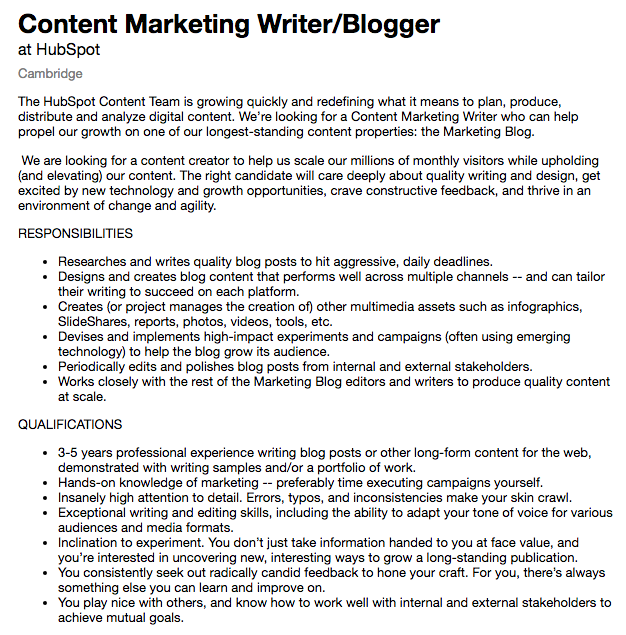
Having found this promising job listing, here's how you might begin customizing your application:
- Create word cloud. As a first check, use a word cloud generator to extract the terms that are used most in the job description. For example, here's what terms stand out in the blogger listing:
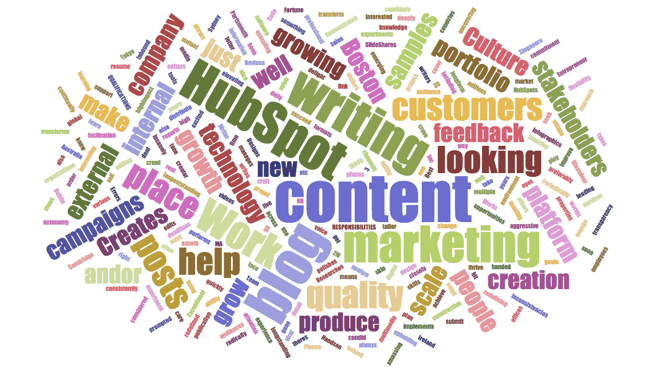
- Scan the job description for technical terms you can repeat in your own writing. This doesn't mean mentioning "high-impact experiments" if you've never actually tested content distribution or format. But it would be wise to replace "designs hero images" on your resume with "creates multimedia assets" to make the connection clear for a recruiter.
- Identify themes between the resonsibilities and qualifications. If the job description repeats a desired quality, you can assume it's a pet rock of the team. For example, the posting stresses the importance of experimentation. Therefore, you should replace or refine the anecdotes of your cover letter to highlight this quality.
- Take notice of culture clues. Sentiments of collaboration and teamwork appear multiple times in this job posting. As you aim to show you have this quality, refer to the company's culture code to inform your language choice.
Beyond tweaking your resume and cover letter for the specific company and role, make sure all instances of your name on the internet -- including your LinkedIn profile, Twitter, Instagram, published clips, and portfolio -- tell a cohesive story. Remember, every aspect of your online presence should scream, "I'm perfect for this job!" before you pick up the phone for your first screening call.
2) Don't limit yourself to formal applications.
"It's not what you know, but who you know." No matter how many times I hear this quote, it still makes my blood boil. In the back of my mind, I hear my post-grad self wine: "But I don't know anyone. How am I supposed to get a job then?"
Even if that saying is true, I would now push back on my former self with a little tough love: If you don't know the right people, make the connections.
No matter what what stage of your career you're in, it won't hurt to reach out to friends, alumni, and former colleagues. Even if you don't know the right person, they might. And that referral can make all the difference. While employee referrals make up only 7% of applications, Jobvite estimates they account for 40% of all hires.
Opt for targeted, personalized emails as opposed to a single spammy message to your entire address book. For an example, take a look at this inquiry email I might send to a former co-worker for potential leads:
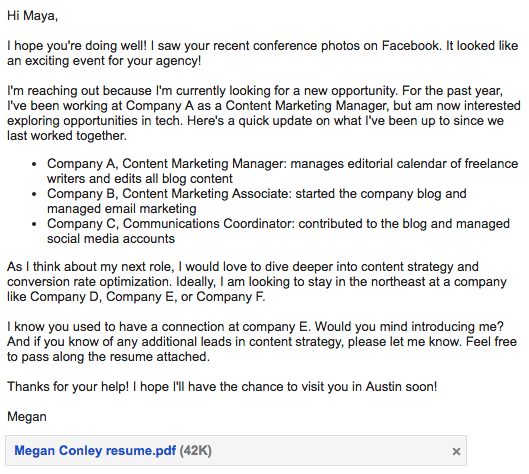
You'll notice that besides attaching my resume, I've shorted my recent experience to a few quick bullet points in the body of the message to make it as easy as possible to scan. I've also included ideal job titles and companies, while of course, thanking them graciously for their support.
As frightening as it may be, emailing second connections or companies of interest without job listings is not out of the question ... as long as you do it in the right way. There's a big difference between a cold email and a genuine, personalized message. Many of my best leads came out of direct messages to content directors, admiring a specific aspect of their work and asking for their creative expertise over a cup of coffee. For those who know me be best, they'll confirm it's completely out of my introverted, Midwestern-nice comfort zone to ever do this. But in the end, your momentary discomfort could pay off tremendously.
3) Reflect on your why.
Most interview questions never change. Why are you interested in this position? What are your top strengths and weaknesses? Where do you see yourself in five years?
Yet, no matter how many interviews you've had, it's still easy to stumble through these questions. According to Charles Duhigg, building mental models and telling yourself stories of potential situations can help control how you think. What could be more helpful in an interview than being able to control your racing mind?
Too often, we wait until the night before an interview (or even the 30 minutes before) to reflect on why we want that particular position and how we'll answer the questions we know are coming.
Instead, move this process to the top of your job search to-do list. Don't settle with just knowing you want a position as a content marketer or project manager. Consider the "why" and write it out. From my experience, the more I wrote out my reflections to common interview questions, the more confident I felt in each of my interviews.
4) Be specific in your search.
At this point, you've compiled a list of dream companies and scoured their individual careers pages. Likely, you'll still want to spend some time on job boards to complete your search.
If you're anything like me, clicking through pages upon pages of job links is not your ideal pastime. In the best interest of your sanity, prioritize your searching on niche job sites. If a company has taken the time (and often, money) to post a position on a niche site as opposed to simply Indeed.com, they are serious about finding the perfect fit. From my experience, companies that prioritize the interview experience also value things like career development, people operations, company culture, and management training later on.
Not sure where to start? Sales Gravy is great for sales jobs, while JournalismJobs.com and Mediabistro are perfect for writers. Be sure to check out Inbound.org for marketing positions.
To stay on top of new listings, most job boards allow you to set up instant alerts that'll immediately email you when a position is posted with specific keywords in your chosen area. Twitter is another option for monitoring job listings in real time. Get yourself in the habit of searching for specific keywords like "marketing job Boston" or "content director." As you find specific companies or job sites tweeting about positions regularly, you can add them to a public or private Twitter List to make monitoring easier.
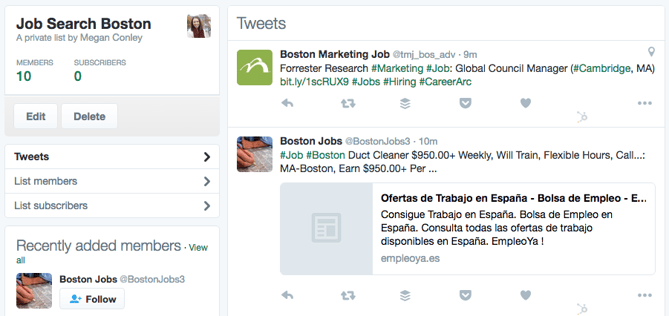
Of course, don't forget to clean up your profile with a nice headshot, creative bio, and link to your porfolio -- that way, when you find the perfect job listing tweet you're ready to start the conversation.
5) Think about timing.
With a stroke of luck, perhaps you do find the perfect job in your endless scrolling through job listings. So, do you stop everything and submit the application as quickly as possible? Besides, you don't want someone else to snatch the position before you do ...
Not so fast. When you find the listing for your dream job, here's might advice: don't apply for it. At least not until you think about your timing.
According to a study by Bright.com, applicants that apply on a Monday are most likely to advance in the hiring process. In fact, nearly one in three job seekers who applied on a Monday moved forward successfully in the hiring process.
Sound like a myth? Considering a separate study by SmartRecruiters found that most applications are submitted on a Tuesday, there could be some truth to the early bird gets the worm philosophy for job searching. The data shows that 18.5% of candidates apply on Tuesday, with 21.5% of hiring decisions also being made on a Tuesday. Therefore, use the weekend to get your cover letter and resume in line. Then, be ready to submit your application before the emails flood the recruiter's inbox on Tuesday afternoon.
6) Stay organized.
While it's nearly impossible to know the average number of applications an individual job seeker fills out before they get an offer, we do know that, on average, 118 people apply for any given job.
There's a lot of factors that affect how long your search will last: your experience level, your network, the time of year, the demand for your skill set in your geographic area. No matter what, you'll probably fill out more applications than you can remember. Therefore, it's absolutely crucial that you stay organized.
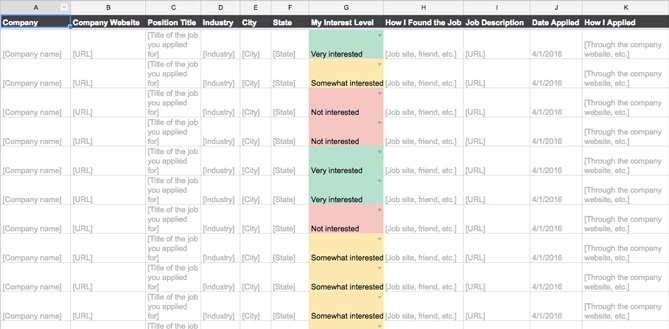
Keep an organized spreadsheet with more information than you think you'll need. There are some obvious inclusions, such as the title of the position, the location, the type of company, etc. But don't forget to include the date you applied, who you included as your references, and the name and email of the hiring manager. That way, when your former boss reaches out to you because of a reference, you'll know exactly how many times you gave out their contact information.
Good news here: We have a job application tracking template ready for you to use as a part of our Interview Kit for Job Seekers. As you proceed through the job search process, use this Google Sheet to keep track of where you are in the interview process with each company and manage all of those new names like a pro (Believe me: I've messed up someone's name in a job interview. It's not fun).
7) Go the extra mile.
What if I told you that your resume doesn't matter? You'd probably question me to some degree. Of course, your resume serves the very important purpose of telling a hiring manager where you've been and what you've done. However, when it comes to making a impression, there is something much more important than a list of bullet points: proof.
Show, don't tell. It's nothing new. In his recent Medium article, writer Raghav Haran spoke of the importance of this through the concept of a "pre-interview project." And not nearly as many people are taking advantage of this opportunity as they should.
The idea is to show your potential employer that you can do the job before you get the job, and often before you even talk to a hiring manager. For a salesperson, that might be reaching out to prospects and introducing them to the team. For a marketer, you could replace the traditional cover letter with a sample campaign, complete with an ebook, social images, and promotional blog post.
The trick is, do the project before they ask. Especially for creative jobs, it's normal for hiring managers to ask final-round applicants to write a blog post or draft a creative brief. But to really stand out, show that you are proactive about solving problems.
8) Don't obsess.
There is a behavioral pattern I seem to follow whenever I'm applying for jobs. 90% of the time, I'm my usual conscientious, rational self. I thoughtfully sort through job listings, take breaks, consider my cover letters word-by-word.
The other 10% of the time, I'm a chaotic mess. Suddenly it hits me how much I need a job and how much I need one right now. In a frenzy of panic, I binge apply. In a single night, I'll power through 30+ typo-ridden applications until I'm too tired to function.
From someone who's fallen prey to this lie more times than I'd like to admit, don't panic. If you're truly being thoughtful about which positions you are applying for, there's a limit to how many you can apply to in a single day, or even a week.
Instead, take your time and form a strategy for each company on your dream list. The irony of obsessing over the job application process is you'll bring yourself to burnout before you even start training for your new position. Don't treat applying for jobs like it's your full-time time job -- it's emotionally exhausting in a way I hope your actual job never is.
No matter who you are, self-promotion is draining and rejection is inevitable. The truth of the matter is, applications can't fill a forty hour week. Keep your expectations reasonable and give yourself adequate breaks to rest, spend time with people, and stretch your creativity. Your future employer will thank you for it.
Unsure if now's the time to start the job search? Take our career development quiz to learn how to accomplish your professional goals.

Tristram Stuart: The Beauty of Ugly Food
- Details
- Hits: 140
National Geographic Live! - Tristram Stuart: The Beauty of Ugly Food
One-third of the world's food is wasted from plow to plate. Author, campaigner, and National Geographic Emerging Explorer Tristram Stuart is on a mission to eliminate food waste through innovative grassroots campaigns and initiatives.
No Donuts for You: Food Truck Discriminates
- Details
- Hits: 0
No Donuts for You: Food Truck Discriminates
Everyday age discrimination happens behind closed doors. What would happen if we brought it out into the open? We hid cameras at a food truck and wouldn’t serve anyone over 40. How would you have reacted? This video is presented by AARP.
How to Train Your Brain to Write More Concisely: 6 Creative Exercises to Try
- Details
- Hits: 0
How to Train Your Brain to Write More Concisely: 6 Creative Exercises to Try
Written by Eddie Shleyner | @VeryGoodCopy
Every time I write, my goal is to write easy-to-read sentences.
I never want my audience to stumble or slow down or start a sentence over. That’s why, whenever possible, I use simple words instead of jargon, periods instead of semicolons, and active voice instead of passive voice. Most importantly, though, that’s why I strive to write concisely.
Framing your message concisely means saying everything you need to say in as few words as possible. It’s one of the most significant steps a writer can take towards clarity and comprehension -- two crucial building blocks when it comes to reader engagement.
But executing succinct writing (much less recognizing when a sentence could be tighter in the first place) doesn't come naturally to most people. Trimming the fat off your writing is a learned skill that requires effort.
The good news is you can start learning and honing that skill today by practicing the exercises below.
6 Exercises That’ll Train You to Write Concisely
By forcing you to either cut word count or stay within a word count, these exercises will help you do two things:
- Hone your writing skills, helping you to keep your sentences tight and powerful.
- Recognize when sentences are wordy in the first place, which is half the battle when it comes to writing concisely.
So come on. Let’s jump in …
1) Write a haiku a day.
A haiku is a Japanese poem. Traditional haikus must have seventeen syllables between three lines: five in the first line, seven in the second line, and five again in the third, like this one by Murakami Kijo:
First autumn morning:
the mirror I stare into
shows my father’s face."
But the 5-7-5 structure is not a hard-and-fast rule. In fact, most modern haikus are written in varying syllabic patterns, like this one by Yosa Buson, written in 5-3-5:
Over-ripe sushi,
The Master
Is full of regret."
Well-written haikus have an elegance to them -- a rhythm. Each words holds weight -- and each syllable is important -- because that’s what the craft demands. And while it’s challenging to create an emotional image when you only have a dozen or so syllables to work with, doing so trains you to think deeply about your writing. It forces you to evaluate the opportunity cost of words.
Try writing a haiku every evening before going to bed. You can write about anything -- your day, your dog, the untouched Scotch tape in your drawer at work -- as long as you hold yourself to one of the predetermined syllabic structures above.
2) Tweet.
By restricting each tweet to 140 characters, Twitter forces you to relay an impactful or interesting or compelling or funny message quickly.
There. That last sentence was 140 characters, which came out to a mere 22 words with which to express why Twitter is an effective training tool for writers. Could I have composed more on the subject? Absolutely. But that’s not the point. The point is to get your point across in as few words as possible.
Tweeting often allows you to sharpen that skill.
3) Freewrite non-stop for 2 minutes, then halve the text.
When freewriting, you only have to follow one rule: don’t stop until the timer goes off.
Everything else is fair game: you can misspell words and forget commas and apostrophes. You can tell a story or give an opinion or paint a picture. As long as you don’t slow down, a freewrite is your opportunity to word vomit (which can actually be fun and cathartic). After two minutes of freewriting, you’ll likely have something verbose in front of you because you didn’t on-the-go edit. Do a quick CTRL-A (Mac users: Command-A) and check the word count. If you’re at 124 words, for instance, then your goal would be to relay the same message in only 62 words.
Run this exercise enough and you’ll start to recognize your negative writing tendencies. In other words, you’ll begin to see patterns in your writing, which will alert you to the bad habits you should watch out for when writing.
For example, are you using too many adverbs? Are your words too complex (“utilize” vs. “use”). Do you lean on the passive voice too much? All these habits will come to the surface when you force yourself to halve the text you just speedily wrote.
4) Simplify Wikipedia paragraphs.
You might be thinking, but Wikipedia articles are already concise. And they are.
Wikipedia is definitely a no-fluff zone, which is why this exercise is so stellar. You see, by forcing yourself to summarize an already to-the-point paragraph into something even more succinct, you put your editing brain into overdrive.
It’s like sprinting the final 100 yards of a five-mile run, when your lungs are shot. Or pushing through one more squat at the gym, when your legs feel like Jell-O. That extra effort goes a long way in terms of developing you physically -- and it will do wonders for your writing, too.
For example, let’s take this 175-word paragraph from the “Corporate history” section of HubSpot’s Wikipedia page:
HubSpot was founded by Brian Halligan and Dharmesh Shah at the Massachusetts Institute of Technology (MIT) in 2006. Shah invested $500,000, which was followed by angel investments from Edward B. Roberts, the chair of the Entrepreneurship Center at MIT and fellow MIT Sloan classmate and Entrepreneur Brian Shin. The company introduced the HubSpot software in beta in 2006 and officially launched it in December 2007. An additional $5 million in funding was raised in 2007, which was followed by $12 million in May 2008, and $16 million in late 2009. The company grew from $255,000 in revenues the first year the software was released to $15.6 million in 2010. Later that year HubSpot announced its acquisition of oneforty. Oneforty began as an app store for Twitter, but shifted into an online resource for social media marketing. The company also introduced new software for personalizing websites to each visitor. According to Forbes, HubSpot started out targeting companies of 1–10 employees, but "moved steadily upmarket to serve larger businesses of up to 1000 employees."
Now let’s condense it into a 52-word bullet:
Founded by Brian Halligan and Dharmesh Shah at MIT in 2006, HubSpot received a series of multimillion dollar capital injections that helped it grow more than 60X in its fourth year of business. That same year, HubSpot announced its acquisition of oneforty, introduced new website-personalization software, and began targeting much bigger businesses."
The end-result is comparable to a CliffsNotes study guide. Or one of those recap snippets summarizing the last episode of your favorite show. In any case, it’s a snapshot -- a concise rundown -- and while it may be challenging to create, it’ll also make you a better writer.
5) Explain a foreign concept in 100 words or less.
Like most of these exercises, this one’s easy to grasp and hard to execute. It asks that you pick an unfamiliar concept or subject, and effectively explain it, in writing, in less than 100 words. That means you have to be concise without being vague. In other words, you should strive to break down the “what,” “why,” and “how” of the concept or subject.
For reference, check out HubSpot’s [In Under 100 Words] series, which makes quick work of some fairly complicated subjects, including Marketing Automation, SEO, and Smarketing.
And remember: by practicing this challenge, you’ll not only sharpen your writing, but you’ll also teach yourself something new.
6) Read Hemingway, Bukowski, and Vonnegut.
In his memoir, On Writing, Stephen King wrote, “If you want to be a writer, you must do two things above all others: read a lot and write a lot. There’s no way around these two things that I’m aware of, no shortcut.”
You heard the master. Writers are readers, too. And if writers want to be concise, they must read other concise writers…
Like Ernest Hemingway, who is said to have written the world’s shortest novel. It’s six words long: “For sale: baby shoes, never worn.”
Like Charles Bukowski, who summed up the essence of his first novel, Post Office, in the book’s opening sentence, which reads, “It began as a mistake.”
Like Kurt Vonnegut, who wrote most of his novels, including his masterpiece, Cat’s Cradle, in a series of chapters that rarely exceeded two pages in length. This concise approach kept his storylines tight, punchy, and addicting. (Read this for more Vonnegut-inspired writing tips.)
The first five exercises in this article will help you to hone your sentences, to keep them succinct and ready to cut. But this last exercise will ensure that you’re reading some of the finest sentences ever written, a practice that will undoubtedly shape your understanding of the craft as a whole, giving you something to strive for and admire.
This is your inspiration. And now that you have it, let’s get to work. Let’s get better.
8 Powerful TED Talks on Designing a More Productive Life
- Details
- Hits: 0
[Editor's Note: This week we have eight dynamic talks to choose from. Click on the title of the program you would like to see,]
8 Powerful TED Talks on Designing a More Productive Life
Written by Leslie Ye | @lesliezye
For many of us, achieving peak productivity can seem like a Sisyphean struggle. Every once in a while, we’ll think we’ve got our inboxes or to-do lists up-to-date, triaged, and under control. And then something else comes along that throws a giant wrench in all our grand plans -- a tempting off-campus lunch, a last-minute request from your boss’s boss, or a cat GIF storm you can’t help but participate in.
And so we end another day feeling like we’ve failed. While accomplishing tasks is certainly part of the picture, being productive isn’t just about checking items off a list. It’s about creating an environment and state of mind that allow you to produce great work.
And although it’s true that staying focused or having the right tools can help keep you from getting derailed, peak productivity is usually a result of the right circumstances, the right project, and the right person.
These eight TED talks cover every aspect of productivity -- from how to literally do the impossible (Tim Ferriss) to how to inject out-of-the-box thinking into your everyday routine (Nilofer Merchant) -- and will leave you with a new perspective on what productivity really means.
8 Inspiring TED Talks That Will Change How You Think About Productivity
1) “Try Something New For 30 Days” by Matt Cutts
Too often, we’re unproductive because we get caught in a rut of bad behavior. We come to work every day and follow the same routine, and are surprised when we haven’t seen a dramatic shift in our output. Many of us have fallen victim to bad habits that are so entrenched they seem impossible to break, and so our lack of productivity continues day in and day out.
Matt Cutts, a software engineer and head of the web spam team at Google, argues that a change in behavior isn’t as hard as we might believe. In this TED talk, Cutts suggests that all you have to do to form a good habit -- or get rid of a bad one -- is to consciously incorporate (or eliminate) it into your routine for 30 days. Using this 30-day challenge model, Cutts wrote a novel, cut out sugar, and laid the foundation to hike Mount Kilimanjaro.
Climbing a mountain may not be on your list of goals, but you can use 30-day challenges to cut unproductive behaviors from your repertoire.
2) “Got a Meeting? Take a Walk” by Nilofer Merchant
Sometimes it’s the smallest things that make the biggest differences. Nilofer Merchant, an author, speaker, and management consultant who has launched more than 100 products globally, has a message for office workers everywhere: Sitting is killing us.
The average person sits for 9.3 hours a day (compare that to 7.7 hours of sleep!), and this lack of physical activity is directly tied to increased risk of breast cancer, colon cancer, heart disease, and type 2 diabetes.
But when are we supposed to find the time to get moving? In her TED talk, Merchant suggests turning meetings -- the other scourge of the American worker -- into an opportunity to walk. Watch her TED talks to discover more benefits of walking, and why getting some fresh air could lead to your next big idea.
3) “Flow, the Secret to Happiness” by Mihaly Csikszentmihalyi
Growing up in Europe during World War II taught Mihaly Csikszentmihalyi, the psychologist who coined the term “flow,” an important lesson -- many of the adults around him weren’t resilient enough to lead normal lives during the war. When he arrived in America, Csikszentmihalyi, now a psychologist, dedicated himself to discovering what makes us happy.
Why is this relevant to you? Because happy people perform better at work, and Csikszentmihalyi thinks the key to true happiness is “flow” -- a creative state where you’re completely immersed in what you’re doing.
Csikszentmihalyi suggests three conditions are necessary to achieve flow -- deep expertise, enjoyment of what you’re working on, and a challenging project that stretches your comfort zone. In his TED talk, you’ll learn why “flow” is an important concept for professionals to understand -- and could be the secret to productivity and happiness in one fell swoop.
4) “What Makes Us Feel Good About Our Work?” by Dan Ariely
Solving the productivity question isn’t just important for individual contributors -- it’s something that’s on business leaders’ minds, too. Everyone wants to know how to create conditions that are optimal to getting the most quality work done.
Dan Ariely, a psychology and behavioral economics professor at Duke who coined the famed “IKEA effect” that causes us to place a high premium on projects we labored especially hard to complete, thinks he knows how leaders can motivate their teams. In this talk, you’ll learn why it’s so important to value people’s efforts, and how small changes in how you give feedback can be crucial for keeping employee morale high.
5) “How Too Many Rules at Work Keep You From Getting Things Done” by Yves Morieux
Yves Morieux, director of Boston Consulting Group’s Institute for Organization, strives to answer one question -- why are people so unproductive? During his time with BCG, Morieux has worked with over 500 companies, and despite advances in technology and increasing efforts to develop good company culture, the question still plagues him.
Morieux thinks we’re facing a “productivity crisis.” Half a century ago, workforce productivity used to grow 5% a year. It grew 3% annually in the 1970s, 2% in the 1980s, and since 1995 has grown less than 1% per year. For the first time in decades, future generations will have less of everything because their predecessors -- us -- have failed to produce more.
But it’s not too late to turn the boat around, says Morieux. In his TED talk, you’ll hear how the traditional principles of efficiency -- clarity, accountability, and measurement -- have resulted in overengineered, excessively complex workplaces and why leaders need to focus instead on fostering and rewarding effective cooperation.
6) “How to Make Stress Your Friend” by Kelly McGonigal
Health psychologist Kelly McGonigal spent the last decade teaching her patients that stress is harmful to your health. And while an eight-year study revealed that people who reported being more stressed had an increased risk of dying, it also found that only the subjects who believed stress was detrimental saw this increased risk.
Yep, that’s a real finding: Only people who believed stress was harmful to their health actually suffered. Pretty crazy, right?
When you’re in the thick of it at work, it can often feel like the sky is falling and no matter what you do, you’ll never be able to accomplish everything you have to. And that can have some pretty nasty effects on your health. But McGonigal argues that through social contact, we’re able to “hack” our brains and literally rewire the way our bodies respond to stress. In her TED talk, you’ll learn her secret to tapping into your body’s natural defenses against stress-induced damage.
7) “Smash Fear, Learn Anything” by Tim Ferriss
Bestselling author Tim Ferriss and a “six-double-espresso-per-day” friend made a pact -- his friend would forgo any type of stimulant for a year if Ferriss, who had never learned to swim, could complete a one-kilometer open water race. Over the course of his life, Ferriss has also taught himself Japanese and made it to the semi-finals of the world tango championships. And he accomplished these feats he’d previously thought were impossible by learning how to approach his fear through deconstruction.
In this TED talk, you’ll hear about how Ferriss breaks down complex challenges into manageable chunks, then proceeds to crush his goals. And the next time you’re facing a seemingly insurmountable challenge at work, adopt Ferriss’ mindset to summit obstacles that suddenly won’t feel so impossible anymore.
8) “How to Stay Calm When You Know You’ll Be Stressed” by Daniel Levitin
It’s all well and good to say that we should revise how we think about stress, but it’s quite another thing to actually change how we think about it. Thankfully, neuroscientist and cognitive psychologist Daniel Levitin has some advice for how to minimize the impact stress has on your daily life.
Levitin advocates practicing “prospective hindsight,” a term coined by psychologist Gary Klein. Also known as the “pre-mortem,” this strategy calls on people to imagine everything that could go wrong as a result of a certain decision, then act accordingly to prevent those things from happening -- a technique akin to a decision insurance policy. In this TED talk, you’ll learn techniques you can use to gather all the information you need to understand those negative possibilities and create systems of thought that help minimize the fallout from unfortunate situations.